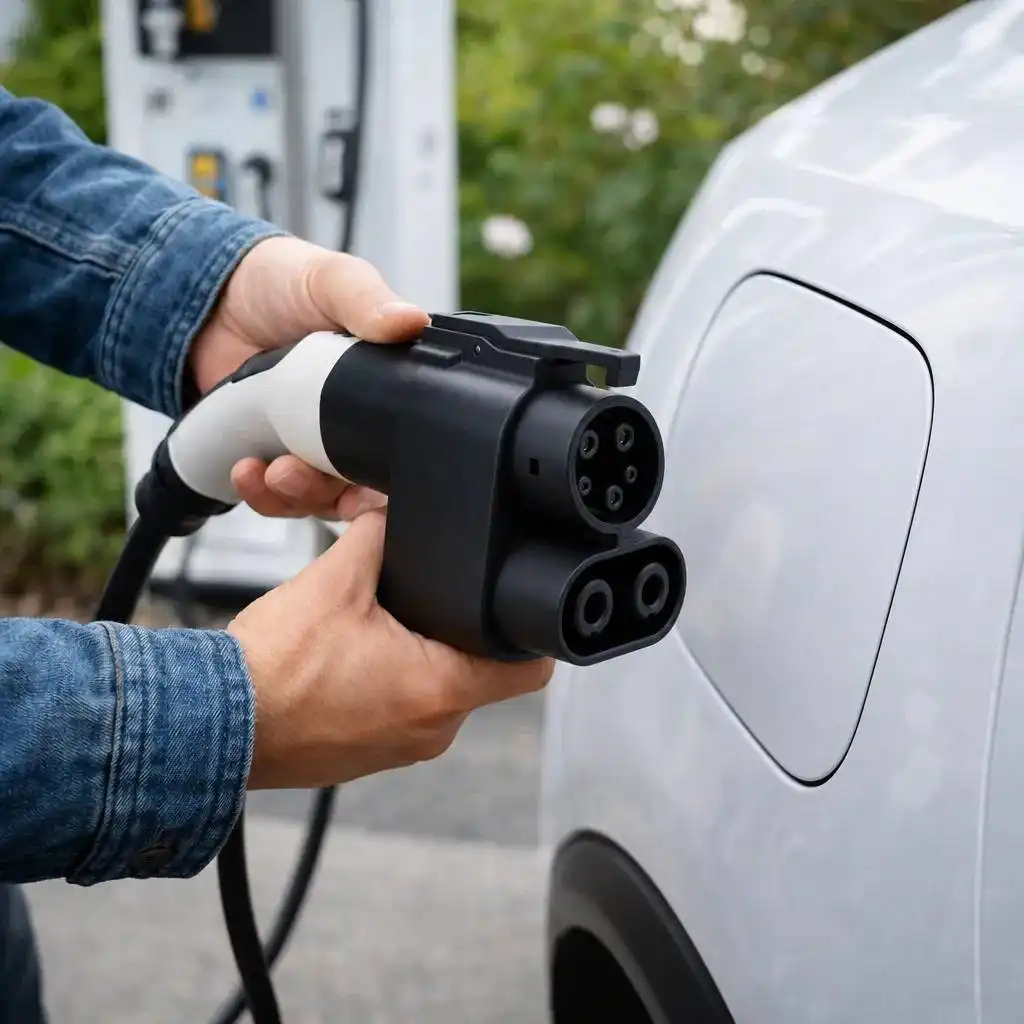
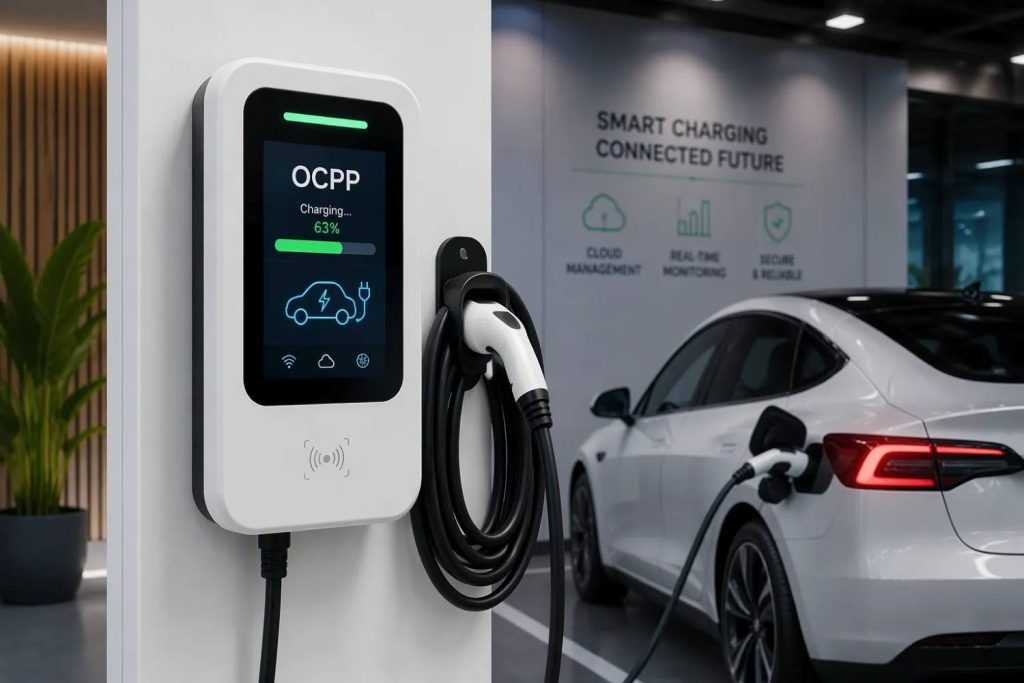
OCPP, or Open Charge Point Protocol, is a common language that lets electric vehicle chargers and management software talk to each other. Without this shared standard, an EV charging station from one brand cannot communicate with software from another. Think of OCPP like a common plug shape that works in every outlet, no matter who made the device. This article explains how OCPP works, compares its versions, outlines its benefits and limits, and helps you choose compliant equipment for your next project.
Key Takeaways
- OCPP lets EV chargers and software from different brands work together.
- OCPP lets operators control chargers from a distance, watch them in real time, and track how much they are used.
- OCPP stops vendor lock-in, so you can swap hardware or software with ease.
- OCPP 2.0.1 gives you better security and smart charging than OCPP 1.6.
- Always check that the device has OCPP certification and test that it works with your system before you buy it.
How Does OCPP Work in an EV Charging Station System?
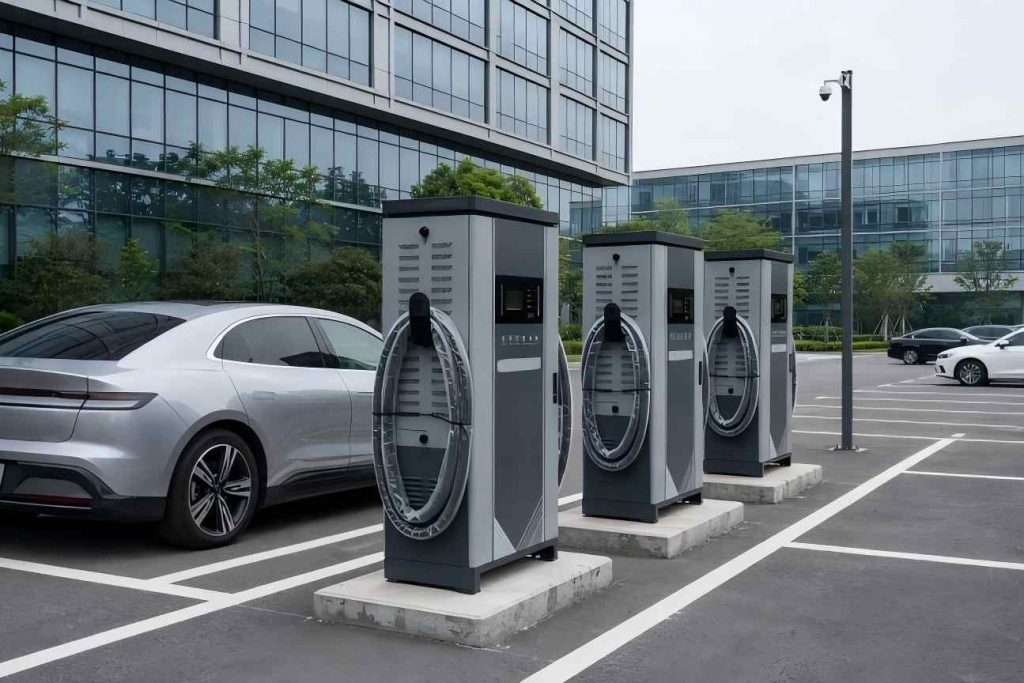
OCPP is the communication protocol between a networked EV charging station and a Charging Station Management System (CSMS). The CSMS allows operators to monitor, control, and manage chargers remotely through standardized two-way messages.
Charging stations send status updates, transaction events, meter readings, and error notifications to the CSMS. These messages help operators track charger availability, monitor energy usage, and identify faults. OCPP 1.6 and OCPP 2.0.1 use different message structures for certain events, so supported features depend on the protocol version.
The CSMS can also send commands to chargers, including remote start, stop, and reset requests. For example, when an operator initiates a remote start, the CSMS sends a request and the charger responds with an acceptance or rejection. The charging session begins once the required conditions are met.
| OCPP Message | Purpose |
|---|---|
| RemoteStartTransaction | Request a charging session to start remotely |
| RemoteStopTransaction | Request a charging session to stop remotely |
These message exchanges provide three key benefits: real-time charger monitoring, remote operation, and transaction tracking for billing and reporting. With OCPP, EV charging stations become easier to manage across multiple locations without requiring staff to visit each site.
What Are the Main Benefits of OCPP for EV Charging Stations?
OCPP improves EV charging station management by connecting charging hardware with backend software through an open communication standard. It gives operators more control, flexibility, and options for expanding their charging networks.
How OCPP Gives EV Charging Station Operators More Flexibility
OCPP enables centralized monitoring, remote diagnostics, configuration changes, and supported firmware updates without requiring on-site visits. Operators can track charger status, analyze usage, and identify maintenance needs more efficiently.
Smart charging features, such as load balancing and power limits, also help distribute electricity across multiple EV charging stations and manage demand as networks grow.
How OCPP Helps Prevent EV Charging Station Vendor Lock-In
OCPP helps reduce vendor lock-in by allowing compatible EV charging stations to communicate with different charging station management systems (CSMS). Operators can choose hardware and software from different providers instead of relying entirely on one supplier.
However, interoperability depends on the OCPP version and implementation. Buyers should verify compatibility and supported features before switching platforms or combining chargers from different manufacturers.
OCPP 1.6 remains widely deployed, while OCPP 2.0.1 and newer versions offer additional capabilities. Choosing a suitable version helps operators plan future upgrades and protect their infrastructure investment.
How OCPP Supports Remote Monitoring and Smart Charging
OCPP enables remote monitoring of charger availability, charging sessions, and error reports. Depending on implementation, operators can also adjust settings, perform diagnostics, and manage firmware remotely, helping reduce downtime and maintenance costs.
Smart charging allows operators to control charging power based on electricity capacity, usage demand, and system settings. This can help prevent overloads, distribute available power efficiently, and support the expansion of commercial EV charging networks.
How to Choose Between OCPP 1.6 and OCPP 2.0.1
OCPP 1.6, released in 2015, remains widely used, while OCPP 2.0.1 introduces enhanced security, device management, and smart charging capabilities. The two versions are not backward compatible, so buyers should confirm hardware and software support before choosing.
| Feature | OCPP 1.6 | OCPP 2.0.1 |
|---|---|---|
| Smart Charging | Preset charging profiles | More advanced charging control |
| Security | Basic security options | Enhanced authentication and certificate management |
| Device Management | Basic configuration | More detailed monitoring and diagnostics |
| ISO 15118 | Limited support | Improved integration |
For existing networks, OCPP 1.6 may remain suitable if it meets current operational needs. New projects involving fleet charging, high-power DC chargers, or advanced energy management may benefit from OCPP 2.0.1.
Upgrading may require more than a firmware update, depending on the charger’s hardware and software design. Before purchasing, confirm the exact OCPP version, supported features, security capabilities, and compatibility with your charging station management system (CSMS). Choose based on project requirements rather than protocol version alone.
Are OCPP EV Charging Stations Compatible With All Software?
OCPP is a way for devices to talk to each other. It is not a plug type, and it does not promise that a charger works well. Two products can both say they follow OCPP and still not work together in real use.
How to Check EV Charging Station and Software Compatibility
Check compatibility before you buy. Ask the seller for the exact OCPP version and certification level. Certification applies to one specific version and setup, not to a whole company or product line. A claim about a company is not something you can verify. Only a public record that names a specific product and version can be checked.
Ask for a test that checks how the charger works with your chosen CSMS platform. Look closely at smart charging profiles, firmware update behavior, and meter value reporting. Test site-level limits by sending a profile at connector zero. Make sure the total load drops and the limit is not wrongly applied to just one connector. Check profile stacking by applying site and session profiles at different stack levels. Confirm the right one takes over when the higher-priority profile ends.
Why OCPP Compliance Does Not Guarantee Full Compatibility
Certification checks one moment in time: a specific firmware build, tested against a specific set of tests, in a controlled setting. Optional features stay optional. A charger can be fully certified while only offering some smart charging functions. Firmware also changes faster than audits. Units ship many versions past the certified one, and smart charging problems are common and rarely written down.
Version mismatches create hard limits. OCPP 1.6 and 2.0.1 do not work together. A 2.0.1-only CSMS cannot run a 1.6 station on its own, and the reverse is also true. This is a full protocol difference, not a setting you can switch. Mixed fleets are common, so the management system must handle both versions.
Feature parity depends on hardware, not just protocol version. The 2.0.1 device model, security profiles, and ISO 15118 Plug and Charge need board-level changes. A 1.6-sized memory budget often cannot carry the 2.0.1 device model, variable store, and security profiles. Whether a 1.6 station can be upgraded by firmware depends on flash and RAM headroom per product. On boards sized for 1.6, it often is not enough.
How Does OCPP Compare With Other EV Charging Standards?
different problem.可以修改成EV charger吗
OCPP is not the only standard used in EV chargers. Two others often discussed in EV charger projects are OCPI and ISO 15118. Each serves a different purpose.
OCPP vs. OCPI: Charging Management and Network Roaming
OCPP manages the charger. OCPI connects charging networks. That single line captures the split.
| Feature | OCPP | OCPI |
|---|---|---|
| Primary Purpose | Manage EV chargers | Connect charging networks |
| Communicates Between | EV Charger ↔ CMS | CPO ↔ eMSP |
| Controls | Charger operations | Roaming and data exchange |
| Typical Deployment | Individual charging stations | Public charging ecosystems |
A roaming session shows how the two work together. The driver opens an app and picks a nearby charger. The app talks to the Charging Point Operator through OCPI to check availability and authorize the session. The CPO passes the request to its management system. That system then speaks OCPP to the physical charger. The charger starts, and session details flow back for billing.
The difference between OCPP and OCPI is that OCPP manages the charger, and OCPI connects charging networks.
OCPP vs. ISO 15118: Charger Management and Vehicle Communication
ISO 15118 defines the link between the vehicle and the charger. OCPP defines the link between the charger and the backend. Together, they cover the full chain.
| Aspect | ISO 15118 | OCPP |
|---|---|---|
| Communication scope | Vehicle-to-charger | Charger-to-backend |
| Plug & Charge | Native, PKI-based | Supported in OCPP 2.0.1 |
| Bidirectional charging | Supported in ISO 15118-20 | Supported in OCPP 2.1 |
ISO 15118 provides Plug & Charge, so drivers skip RFID cards and apps. It also shares state of charge data, which helps smart charging decisions. OCPP 2.0.1 forwards requested energy amounts to the backend, complementing that vehicle data.
For buyers, the practical step is simple. Ask any supplier, including DongYu, about certification level, supported OCPP version, and the upgrade path. A manufacturer offering OCPP-compliant AC and DC EV chargers with OEM/ODM services can confirm these details before you commit.
How Is OCPP Used in Different EV Charging Station Applications?
OCPP supports different EV charging station applications through centralized communication between chargers and backend software. Public networks focus on access and billing, while private installations prioritize energy management and charging availability.
Using OCPP for Public EV Charging Station Networks
Public EV charging networks use OCPP to monitor charger status, manage charging sessions, and support remote start and stop functions. When integrated with compatible backend software, it can also support RFID or app-based access, billing, pricing management, and usage reports.
For operators managing stations across multiple locations, centralized monitoring simplifies maintenance and helps identify faults without visiting every site. Smart charging features can also distribute available power across chargers to help prevent electrical overloads.
Using OCPP to Manage Workplace and Fleet Charging Stations
Workplace and fleet charging stations use OCPP to control access, monitor charging activity, and manage electricity consumption. Operators can configure charging schedules, set power limits, and distribute available capacity across multiple vehicles.
For example, a fleet depot can limit the combined power of several chargers when electrical capacity is restricted. Charging schedules can also prioritize vehicles that need to be ready for upcoming departures, helping reduce downtime and improve fleet efficiency.
Using OCPP for Residential and Commercial EV Charging
Residential EV charging applications can use OCPP-compatible chargers to support remote monitoring, charging schedules, and power management through compatible software. These features help homeowners track charging activity and manage electricity use.
In commercial properties such as hotels, shopping centers, and office buildings, OCPP supports centralized charger monitoring, access management, and charging data collection. Property operators can manage multiple charging points more efficiently and expand their EV charging infrastructure as demand grows.
What Should You Check When Choosing an OCPP EV Charging Station?
Buyers need a clear checklist before picking any OCPP hardware. The Open Charge Alliance keeps a public list of certified products. This list is where all checks should start.
How to Evaluate OCPP Support Before Buying EV Charging Stations
Start by checking the official certification record. Confirm that the manufacturer, product name, product type, and OCPP version match the proposed EV charging station. Also verify the certified firmware version, supported profiles, and certificate status.
| Verification Item | What Buyers Should Check |
|---|---|
| Certificate number | Confirm the certificate is valid and active |
| Manufacturer and product | Match the quoted model to the certification record |
| Product type | Verify whether it covers a charger or management system |
| OCPP version and profiles | Confirm the required version and supported features |
| Firmware version | Match the certified version to the purchased equipment |
| Certificate status | Check for withdrawal or replacement |
If details do not match, ask the supplier for clarification. Confirm security features, including TLS configuration and certificate management. Specify the required OCPP version in the RFQ instead of relying on future upgrades.
Why Testing Matters for EV Charging Station Interoperability
OCPP compliance alone does not guarantee full interoperability. Compatibility depends on the charger model, firmware, supported features, and charging station management system (CSMS).
Before deployment, test the proposed charger and firmware with the intended platform. Verify essential functions such as charging sessions, remote controls, smart charging, and transaction records. Treat switching platforms and upgrading OCPP versions as separate changes, and test both before rollout.
OCPP helps keep EV charging infrastructure flexible by supporting communication between compatible chargers and management systems. Choosing certified equipment and verifying real-world compatibility can reduce vendor dependence and protect long-term investment.
Frequently Asked Questions About OCPP in EV Charging
What Is the Difference Between OCPP 1.6 and OCPP 2.0.1?
OCPP 1.6 supports core functions such as charging transactions, status monitoring, and basic smart charging. OCPP 2.0.1 adds stronger security, advanced device management, and improved smart charging features. The two versions are not backward compatible, so check compatibility before upgrading.
Can OCPP EV Charging Stations Work With Different Software?
Yes. OCPP enables EV charging stations to connect with compatible charging station management systems (CSMS) from different providers, reducing vendor dependence. Compatibility depends on the OCPP version and supported features.
Does OCPP Support Smart Charging and Remote Management?
Yes. OCPP supports load balancing, charging power limits, remote monitoring, diagnostics, configuration, and supported firmware updates. Available functions depend on the OCPP version and implementation.
What Is the Difference Between OCPP and OCPI?
OCPP connects EV charging stations to backend management systems for monitoring and control. OCPI enables communication between charging networks and e-mobility service providers, supporting roaming and charging information exchange. In short, OCPP manages chargers, while OCPI connects charging networks.